


POCO just launched a new device in the Philippines, the POCO F9 Pro.
Aside from being a newer model compared with the POCO F8 Pro, does it bring changes to its hardware and software?
Here’s a quick comparison of the devices.
Design and Build
The POCO F9 Pro measures 157.49mm in height, 75.25mm in width, and 8.79mm in thickness, with a weight of 206 grams.
The POCO F8 Pro has the same height and width but is thinner at 8.0mm and lighter at 199 grams.


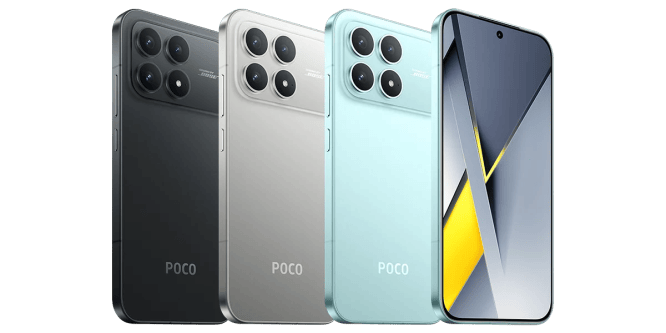
Both phones have an IP68 rating for dust and water resistance. The F9 Pro also features an ultrasonic in-display fingerprint sensor and comes in Black, White, and Aurora Green.
Display
Both models feature a 6.59-inch AMOLED display with a 2510 × 1156 resolution.
The F9 Pro has a higher refresh rate of up to 185Hz, compared with 120Hz on the F8 Pro. It also has a higher listed peak brightness of up to 4500 nits, while the F8 Pro reaches 3,500 nits.


Both displays support 12-bit color depth, DCI-P3 wide color gamut, HDR10+, Dolby Vision, and Gorilla Glass 7i.
Camera
The F9 Pro features a triple rear camera setup consisting of a 200MP main camera with OIS, a 50MP telephoto camera with OIS, and an 8MP ultrawide camera.
The F8 Pro also has three rear cameras but uses a 50MP main camera with OIS, a 50MP telephoto camera, and an 8MP ultrawide camera.


For selfies, the F9 Pro has a 32MP front camera, while the F8 Pro has a 20MP front camera.
The F9 Pro supports up to 4K video recording at 60fps. The F8 Pro supports up to 8K recording at 30fps.
Performance
The F9 Pro is powered by the Snapdragon 8 Elite Gen 5 V Series, while the F8 Pro uses the Snapdragon 8 Elite. Both chipsets use a 3nm process.
What’s new here is that the POCO F9 Pro also includes a dedicated VisionBoost D8 graphics chipset. It is designed to provide additional graphics processing for features such as super resolution, smart frame rate, and Game HDR.


Both phones come with 12GB of LPDDR5X RAM and UFS 4.1 storage, with 256GB and 512GB options and both of the devices run on Xiaomi HyperOS 3.
Battery and Charging
The F9 Pro has a 6,330mAh battery, slightly larger than the F8 Pro’s 6,210mAh capacity.

Both support 100W wired charging. However, the F9 Pro adds 50W wireless charging, which is not listed for the F8 Pro.
The F9 Pro supports up to 27W wired reverse charging and 22.5W wireless reverse charging. The F8 Pro supports up to 22.5W wired reverse charging.
Price
In the Philippines, the POCO F9 Pro is priced at:
- 12GB + 256GB – PHP 49,999
- 12GB + 512GB – PHP 54,999
The POCO F8 Pro is priced at:
- 12GB + 256GB – PHP 29,999
- 12GB + 512GB – PHP 31,999
This puts the F9 Pro PHP 20,000 higher for the 256GB model and PHP 23,000 higher for the 512GB model.
POCO F9 Pro vs POCO F8 Pro Specs

| Specs | POCO F9 Pro | POCO F8 Pro |
|---|---|---|
| OS: | Xiaomi HyperOS 3 | Xiaomi HyperOS 3 |
| Network: | Dual SIM / eSIM | 5G | Dual SIM / eSIM | 5G |
| Connectivity: | Bluetooth 6.0 | Wi-Fi 7 | NFC | Bluetooth 5.4 | Wi-Fi 7 | NFC |
| Dimensions: | 157.49 × 75.25 × 8.79mm | 157.49 × 75.25 × 8.0mm |
| Weight: | 206g | 199g |
| Resolution: | 2510 × 1156 | 2510 × 1156 |
| Refresh Rate: | Up to 185Hz | Up to 120Hz |
| Screen Size & Display: | 6.59-inch AMOLED | 6.59-inch AMOLED |
| Chipset: | Snapdragon 8 Elite Gen 5 V Series | Snapdragon 8 Elite Mobile Platform |
| Graphics: | Adreno GPU + VisionBoost D8 dedicated graphics chipset | Adreno GPU |
| RAM: | 12GB LPDDR5X | 12GB LPDDR5X |
| Storage: | 256GB / 512GB UFS 4.1 | 256GB / 512GB UFS 4.1 |
| Rear Camera: | 200MP main (OIS) + 50MP telephoto (OIS) + 8MP ultrawide | 50MP main (OIS) + 50MP telephoto + 8MP ultrawide |
| Front Camera: | 32MP | 20MP |
| Battery & Charging: | 6,330mAh | 100W wired | 50W wireless | 27W wired reverse | 22.5W wireless reverse | 6,210mAh | 100W wired | 22.5W wired reverse |
| Color/s: | Black, White, Aurora Green | Black, Titanium Silver, Blue |
Verdict
The POCO F9 Pro brings several upgrades over the F8 Pro, including a newer chipset, higher 185Hz refresh rate, brighter display, 200MP main camera, higher-resolution selfie camera, larger battery, and wireless charging.
Overall, the F9 Pro offers more hardware features than the F8 Pro, but the price difference is substantial.
The F8 Pro remains the less expensive option, while the F9 Pro targets users looking for the newer hardware and additional display, camera, and charging features.
Which one would you choose?